
Digital Printing vs Offset Printing: Which Is Better for Business Printing?
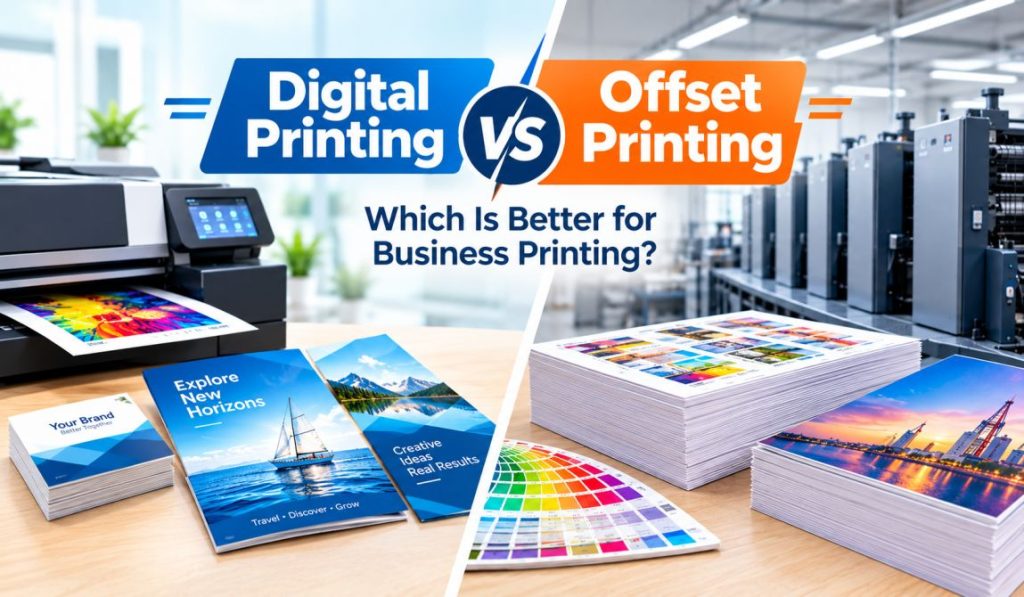
Businesses often focus on design, paper quality, and price when ordering printed materials. However, the printing method can also affect the final cost, production time, colour consistency, and flexibility of an order.
For example, a business printing 200 brochures for a sales meeting has different requirements from a company distributing 5,000 brochures across multiple branches. The first may benefit from digital printing, while the second may find offset printing more economical.
Understanding digital printing vs offset printing helps businesses choose a method that suits their order instead of paying for production they do not need.
Both methods can deliver professional results. The main differences lie in setup costs, order quantities, turnaround time, personalisation, and the materials involved.
Digital Printing vs Offset Printing: A Quick Comparison
Factor | Digital printing | Offset printing |
Setup | No printing plates required | Requires printing plates |
Small orders | Usually more economical | Setup costs can make small runs expensive |
Large orders | Cost per copy may be higher | Often more economical at scale |
Turnaround | Generally faster for short runs | Requires additional setup time |
Personalisation | Supports changing content between copies | Conventional production is suited to identical copies |
Colour matching | Good for many standard printing jobs | Supports specially mixed Pantone inks |
Materials | Depends on digital press capabilities | Often supports a wider range of stocks and specialist requirements |
Best suited for | Short runs, urgent jobs, personalised prints | Large runs, consistent output, and certain specialist print jobs |
The most suitable option depends on the printing specifications and supplier capabilities. There is no universal quantity at which offset automatically becomes cheaper, so comparing quotations is worthwhile for orders near the break-even point.
What Is Digital Printing?
Digital printing transfers artwork directly from a digital file onto paper or another compatible material. Depending on the equipment, the process uses inkjet technology or toner-based printing.
Because printing plates are not required, preparation is relatively simple. This makes digital printing useful for businesses that need small batches, frequent design updates, or personalised materials.
For example, a company preparing 150 business cards for a new sales team can print the cards with different employee names and contact details without producing separate printing plates for each version.
Digital printing is commonly used for:
- Business cards and corporate stationery
- Short runs of brochures and flyers
- Event invitations and promotional materials
- Personalised direct mail and event passes
- Marketing materials that need frequent updates
Advantages of digital printing
- Lower initial setup costs for small orders.
- Faster production for many short-run jobs.
- Easier personalisation of individual copies.
- Greater flexibility when artwork or information changes.
- Less risk of being left with large quantities of outdated printed stock.
Disadvantages of digital printing
- The cost per copy may be higher for large quantities.
- Some specialist papers, inks, and finishes may not be compatible with the equipment.
- Exact reproduction of certain Pantone colours may be limited.
- Colour consistency between separate print runs depends on the equipment, calibration, and production process.
Businesses planning short-run marketing materials can explore digital printing services to understand how this approach may fit their requirements.
What Is Offset Printing?
Offset printing is a commercial printing method in which ink transfers from printing plates to a rubber blanket before being applied to paper. Separate plates are generally used for the different colours in a full-colour design.
The preparation process takes more time than digital printing. However, once the press is set up, it can produce large quantities of identical materials efficiently.
Offset printing is particularly useful when a business needs thousands of copies of the same design, with consistent reproduction across the production run.
Common applications include:
- Large quantities of brochures and product catalogues
- Corporate stationery and letterheads
- Bulk promotional flyers and leaflets
- Commercial publications
- Print jobs requiring specific spot colours or specialist production methods
Advantages of offset printing
- Lower cost per copy can be achieved on large orders.
- Consistent colour reproduction across long production runs.
- Supports specially mixed Pantone inks when the press and specifications allow.
- Offers a broad range of paper stocks and certain specialist printing options.
- Suitable for recurring orders that use the same artwork.
Disadvantages of offset printing
- Printing plates and press setup increase initial costs.
- Production usually takes longer to begin.
- Small orders may not justify the setup expense.
- Changes after plate preparation can add cost and delay production.
- Conventional offset printing is less practical for personalising every copy.
Offset printing is worth considering when a business has a large, clearly defined order and sufficient time for production.
1. Cost and Quantity: Which Method Offers Better Value?
The number of copies required is often the first factor to consider.
Digital printing avoids plate-making costs, so it is generally more economical for small orders. Offset printing has higher initial costs, but those costs are spread across more copies as the production quantity increases.
Consider two business scenarios:
Scenario A: A small marketing campaign
A company needs 200 flyers to promote a new service at a local event. Digital printing may be the more practical choice because the business can order the quantity it needs without paying for a large production run.
Scenario B: A multi-location promotion
A retailer needs 5,000 identical flyers for distribution across several branches. Offset printing may offer a lower cost per flyer because the initial setup cost is spread across the larger order.
These examples are illustrative, not fixed pricing rules. The actual break-even point depends on the paper, dimensions, colour requirements, finishing, and printer’s quotation.
When comparing costs, include trimming, folding, lamination, binding, packaging, and delivery. A lower printing price does not necessarily mean a lower total project cost.
2. Turnaround Time: Which Method Is Faster?
Digital printing is generally the better starting point when a business has a tight deadline and needs a relatively small quantity.
Without plate preparation, production can begin once the artwork is approved and the digital press is ready. This can be useful for last-minute presentations, event invitations, updated price lists, and short promotional campaigns.
Offset printing requires additional preparation before the main production run begins. However, it can produce large quantities efficiently after setup.
For example, a company preparing 100 presentation brochures for a meeting next week may prefer digital printing. A business ordering thousands of catalogues for a planned campaign may have enough time to consider offset production.
The final deadline also depends on finishing, binding, proof approval, stock availability, and delivery. Always confirm the complete schedule rather than relying on the printing method alone.
3. Colour Accuracy and Print Quality
Both digital and offset printing can produce sharp text, detailed images, and professional-looking marketing materials. The difference becomes more important when a project has strict colour requirements or needs consistent results across a large run.
Digital presses can reproduce a wide range of colours for everyday commercial printing. However, some Pantone spot colours may need to be approximated using the press’s available colour system.
Offset printing can use specially mixed Pantone inks when exact spot-colour reproduction is required. This can be useful for brand-critical materials where a particular colour must be matched closely.
For example, a business producing a small batch of promotional flyers may find digital printing entirely suitable. A company printing large quantities of stationery in a specified brand colour may want to compare offset printing with a suitable digital alternative.
Neither method guarantees a perfect match in every situation. Paper colour, coating, ink, calibration, and viewing conditions also affect the result. For important brand colours, ask for a proof and confirm the colour requirements before approving production.
4. Personalisation and Variable Data Printing
Digital printing is particularly useful when each printed item needs different information.
Variable data printing allows names, addresses, QR codes, reference numbers, or other details to change from one copy to another within the same production run.
For example, a company sending invitations to 300 customers can include a different recipient name on each invitation. A business organising a conference can also use individual attendee details on event passes.
Traditional offset printing is designed primarily to reproduce the same artwork across the run. Personalising every copy is less straightforward and may require additional processes.
If the design remains identical across all copies, either method may work. If the content changes from person to person, digital printing is generally the more practical choice.
5. Which Printing Method Is Better for Different Products?
The best method also depends on what your business needs to produce.
Business cards
Digital printing works well for small batches, new employees, and cards that need frequent updates. Offset printing may be worth considering for larger quantities or projects that require particular spot colours and specialist finishes.
The decision should account for the quantity, paper stock, finish, and how frequently the cards will need to be replaced.
Brochures and catalogues
Digital printing is suitable for small batches, updated product information, and materials prepared for a particular event.
Offset printing may be more cost-effective for thousands of identical brochures or catalogues, particularly when consistent colour reproduction is important.
For a product catalogue that changes every few months, smaller digital runs can also help prevent businesses from holding outdated stock.
Flyers and promotional leaflets
A small campaign or event may only require a few hundred flyers, making digital printing a practical option. Large promotional campaigns involving thousands of identical copies may benefit from offset printing.
For example, a business testing two versions of a promotional offer can use digital printing to produce limited batches before committing to a larger run.
Corporate stationery
Digital printing suits smaller stationery orders and documents that require frequent updates. Offset printing may be appropriate for larger quantities of standard letterheads and other materials that use a fixed design.
The key consideration is whether the business values flexibility or economies of scale more.
Posters and premium marketing materials
The choice depends on the poster size, viewing distance, material, colour requirements, and finishing options. Some posters are better suited to large-format printing, while other commercial poster jobs may be appropriate for offset production.
Do not assume that offset is automatically the best choice for every large poster. The required dimensions and available equipment should guide the decision.
6. What Should You Check Before Choosing a Printing Method?
Before requesting a quotation, prepare a clear brief with the following information:
- Quantity: How many copies are required, and are future reorders likely?
- Dimensions: What are the finished size and layout requirements?
- Artwork: Is the design final, or are changes expected?
- Paper and finish: Are particular paper weights, textures, coatings, or binding methods required?
- Colour specifications: Does the project require a particular Pantone colour or consistent brand reproduction?
- Personalisation: Will every copy contain the same content?
- Deadline: When must the finished materials be ready?
- Total budget: Does the quotation include finishing, packaging, and delivery?
It is also worth considering the cost of unused stock. Ordering 5,000 brochures may reduce the cost per copy, but the saving could be lost if product details or prices change before the brochures are distributed.
For businesses that frequently update their marketing materials, a smaller print run may provide better overall value even if each copy costs more.
Conclusion: Digital or Offset Printing?
Digital printing is generally the more practical option for short runs, personalised materials, and projects that require flexibility or a quick turnaround. Offset printing often offers better economies of scale for large quantities of identical materials and can accommodate specific colour and production requirements.
Before choosing, compare the complete cost, required quantity, deadline, and finished-product specifications. If the order is large enough for either method to be viable, ask for quotations for both rather than relying on a fixed quantity threshold.
Blue Ridge Advertising helps businesses with their printing requirements. Reviewing the specifications of your project before placing an order can help you choose an appropriate printing method, manage costs, and avoid unnecessary waste.